







viewporn@interiorvilla1

P R I V A T E J E T I N T E R I O R S C A P E



.png)
All rights reserved - JetCabin Freshbook Magazine, a Jet Media Company
Issue 29 / September, 2025


Who We Are
Photo by: Dave Koch
JET CABIN FRESHBOOK Magazine is the world's only all-digital publication focussed entirely on jet interiors. We do not publish broad spectrum aviation news or content. The magazine and it's goals were an outgrowth of our founder's career-long profession as a designer of VVIP aircraft interiors. His singularly focussed goal in establishing JCF Magazine was to present Designers, Completion Centers, Flight Departments and Purchasing Agents with the very latest and most innovative interior related products and services by the top cabin suppliers from around the world. JCF provides in-depth coverage of the latest design trends, new materials, emerging technologies and continually showcases the world's top designers. To this day JCF Magazine maintains the most comprehensive categorized listing of Cabin Supplier Groups - worldwide.
JCF Magazine is also proud to maintain the world's only fully comprehensive global listing of top aviation interior designers from around the world. GLOBAL DESIGN ROSTER was developed exclusively for Operators & Flight Departments in need of design resources as they approach new projects. Each of the more than sixty renown designers have been vetted and most have OEM certifications and other industry accepted credentials and awards.
Our key areas of coverage are: Interior Cabin Design / Cabin hygiene / Cabin management • Food & Galley Service • Completions and Refurbishment / Carpet & Flooring / IFE and CMS / Lavs / Lighting / Seating /Textiles and leather / Trends & Emerging Technologies - and all relevant news directly related to interiors.
Jet Cabin Freshbook Magazine is a Jet Media company . Santa Fe, NM (USA) Founder / Editor: Richard Roseman
info@freshbook.aero ph: +1 (214) 415.3492. Advertising Opportunities Editorial: editorial@freshbook.aero Archive: Past Issues
There has never been a better time to own a private jet — and not just because of where it can take you, but because of how you feel when you arrive. The latest generation of business aircraft have made amazing strides in passenger well-being, turning the cabin into something closer to a spa than a pressurised tube hurtling through the stratosphere. These strides have been gradual and incremental, so often not noticed.
Cabin altitude is perhaps the single biggest story here. Where older aircraft typically maintained a cabin altitude of 8,000 feet, many of today's flagships — from the Gulfstream G700 to the Bombardier Global 7500 — bring that figure down to 4,000 feet or below at cruise. The difference is tangible, and the effects remarkable. Lower cabin altitude means higher oxygen levels, reduced fatigue, and far less of that groggy, dehydrated feeling that used to be an unavoidable tax on long-range travel. Your body, quite simply, works less hard to keep you comfortable.
Lighting has undergone an equally impressive evolution. Circadian-tuned LED systems now shift colour temperature and intensity throughout the flight, gently nudging your body clock in whichever direction you need — whether that means staying sharp for a board meeting on arrival or easing into restful sleep over the Atlantic. It is a small detail with a disproportionately large impact.
Humidity control, whisper-quiet cabins, advanced air filtration, and ergonomically refined seating round out a picture of genuinely thoughtful engineering. Manufacturers are increasingly consulting physicians, sleep scientists, and nutritionists during the design process — and it shows!
For owners, this translates into something straightforward and deeply valuable: you step off your aircraft feeling like yourself.
In a world where time is the ultimate currency, arriving well is as important as arriving at all.

Richard Roseman -
Publisher / Editor
E D I T O R I A L B E G I N S H E R E
Got something to say? Do you have something newsworthy...something that's about to set the industry on its heels? We're interested in hearing about it. The only thing that makes us relevant and worthy of our subscribers and followers is the content we carry. Our entire reason for being is to bring the FRESH, the latest and greatest and the most useful interior innovations to our readers.
Let us here from you: editorial@freshbook.aero

%20copy%202.png)
Flying High, Feeling Better


H O W A R D G U Y / D Q D E S I G N & P R O T O T Y P E S

.png)
T H O M A S C H A T F I E L D

Heading 2
V I S I O N
We're Changing The Way You Think About Aviation Magazines
No flip viewrs, no thumbing pages. No zooming to read text, or adjusting scale to see images. Just smooth scrollable content, smartly written feature articles, full width ads from the top companies in the world. Plus excting departments that bring the FRESHEST in new product innovations and rollouts. If it's trending in interiors, you'll find it here. If it's not quite here yet, you'll learn about it before it hits.
And best of all, it's interactive, with video, live links and instant access to the people, products and extended content you're interested in



Owner / Operators and Flight Departments, Welcome Aboard.

Five years ago when we launched Freshbook Magazine, it had one purpose: to pull together the entire global community of interior related companies - Cabin Suppliers, Completion Centers and Design Studios. In fact we're only one of two magazines in the world that focuses entirely on jet cabin interiors - and we're the sole such all digital publication.
But today, we're extremely proud to announce a NEW permanent segment to our magazine. Up until little more than a year ago, 100% of our subscribers and social media followers were 'companies' in one of the three categories above. Today, however, Owner / Operators & Flight Departments account for almost 9% of our subscriber base - and it's growing. It's been a very organic trend and without solicitation. Yet, as you might imagine, we're very happy about this new top-tier subset of Freshbook subscribers, a group whose newfound attention adds obvious value to the advertisers and readers we serve!
Check out our exclusive, entirely dedicated page for this new very special audience!

Owner / Operators, Welcome Aboard.


It’s not a refusal – perish the thought – but it is a price tag that functions as one. Call it the “I’d rather not” tax, invoiced at two million dollars and suddenly the inconvenience of incorporating something non-standard simply… goes away.
Thomas Chatfield - Executive Contributor &
CEO - Camber Aviation Management
T
here was a point in your life when owning a private jet was the single coolest thing you could imagine. You might have drawn it with crayons and given it flames down the side, probably, or lightning bolts, or your name in letters big enough to read from the ground. You weren’t thinking about colour palettes. You were thinking about how unbelievably, impossibly brilliant it would be to have your own jet.
- T h o m a s C h a t f i e l d
This is the 13th installment of Airborne Cafe. We are proud to embark on this ongoing series of thoughts, extollings, and stories from one of the premier figures in our industry. In each issue, Thomas Chatfield will offer us thought-provoking articles like the one above - each of them relevant and insightful from the perspective of private aviation. Simply hit the link at right to finish the article, and while you're there, learn more about Camber Aviation Management and the importance of their work

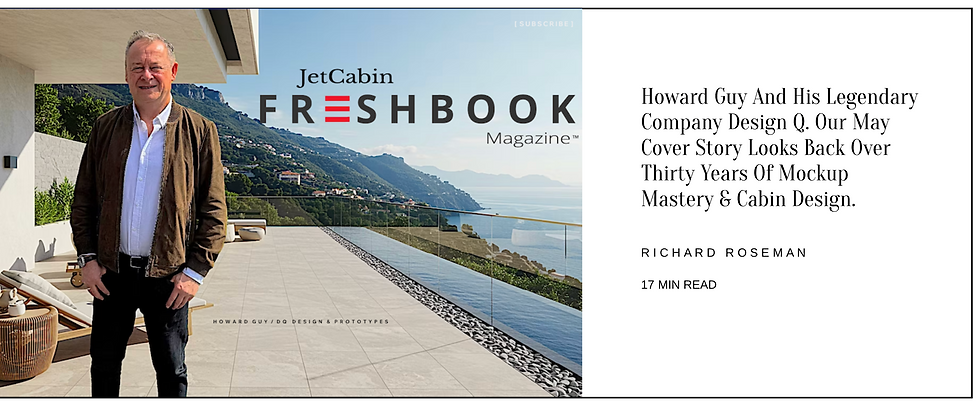
Mockup Mastery. How Design Q Rewrote the Rules of Full-Scale Aviation Mockups.
Chainsaw-wielding rockstars, last-minute three-day seat builds, and a mockup that sold itself for ten million dollars more than planned. Howard Guy, CEO of DQD&P, has had one of the most improbable careers in aviation design — and he’s only just getting started.
Cars, Concepts, and a Call from Richard Branson
Howard Guy didn’t come to aviation through the usual door. He came through the garage. Trained in industrial design with a background steeped in car culture, Guy founded Design Q with the mindset of an automotive studio — fast concepts, tight timelines, obsessive attention to fit and finish. What he didn’t know was that this seemingly sideways approach would eventually make him one of the most distinctive voices in aircraft interior design.
How Design Q Rewrote the Rules of Full-Scale Aviation Mockups.


Guy’s team said: “Let’s figure it out.” Virgin Atlantic became the world’s first airline to fit airbags in the main cabin. Which is either a testament to what happens when car people and aviation dreamers collide — or proof that Richard Branson will greenlight almost anything if you frame it correctly.
Timeline and Budget Expansion
The complexity of VVIP aircraft completion makes it particularly vulnerable to timeline and budget overruns. A typical large cabin completion might take 12-18 months (even longer for a wide-body) and cost well into nine figures, but unforeseen challenges frequently extend both. Custom parts may fail certification testing, requiring redesign and remanufacturing. Supply chain issues for exotic materials can cause cascading delays. Client-requested changes midway through completion can necessitate undoing months of work and creating new solutions. The most successful projects require meticulous planning, clear client communication, and considerable contingency allowances.
Technical Integration Nightmares
Modern VVIP aircraft contain extraordinarily complex systems that must function together flawlessly. Entertainment systems, communication equipment, lighting controls, and environmental systems require miles of wiring and countless integration points. When proprietary systems from different manufacturers must communicate seamlessly, technical conflicts emerge that can take months to resolve. The most challenging integration issues often arise late in the completion process when systems are being activated and tested together for the first time. “While the risks always remain, it is the task of the outfitter’s engineering team and the completion manager to develop processes to allow the various components and software to be tested thoroughly on the work bench to identify issues while there is still time to thoughtfully (and not under the pressures of an upcoming completion date) identify and implement solutions before the systems are installed.”
Courage.

The art of VVIP aircraft design and completion ultimately comes down to balancing competing priorities: luxury versus weight, innovation versus certification, customization versus timeline, opulence versus functionality and convenient fit versus ergonomics. The most successful projects maintain a clear hierarchy among these priorities based on client preferences while establishing transparent processes for resolving inevitable conflicts.


Story by: Martin Waletzko
Business & Go-to-Market Strategist, Founder @ WEYOU

I N T H I S I S S U E
J A N U A R Y F E A T U R E A R T I C L E S

If the Van Der Rohe chair pictured above is iconic, then the Eames chair is in the stratosphere. Pretty much every designer I know has one of these in their living room or studio. They exude cool and they are inarguably the most comfortable lounger in history.
There's NO man who doesn't want one of these on their airplane! Unfortunately, there is also NO regulatory agency that's going to let that happen. But, since certified aircraft chair frames are relatively thin to begin with, we could be getting close in the not-too-distant future.


Issue # 32 MAY, 2026 Globally recognized leader for Jet Cabin Interior News, Trends, and Innovations
a Jet Media LLC company All Rights Reserved
Howard Guy
Maintaining Privacy and Security
For clients who are heads of state, royal family members, or public figures, security and privacy concerns add another layer of complexity. Although it’s rare for your run-of-the-mill billionaire, head-of-state aircraft often incorporate sophisticated defense systems, secure communications, and sometimes even medical facilities—all without compromising the aesthetic experience. Information security during the design and completion process itself becomes crucial, with industrial espionage and security threats requiring strict protocols for all involved parties. This may not apply to you if you’re moving from a Gulfstream or Global into your first large cabin aircraft – but they are considerations depending on your own security needs.

%20copy%203.png)




Story by: Melissa Tokoriyama
Special Features Contributor


Article by
R I C H A R D R O S E M A N
N
othing starts without a design...and nothing commands our attention like a great one. But a design, like the product of any creative endeavour, is ultimately judged by the pair of eyes looking at it. Yet within the framework of a design competition or an open evaluation conducted by hundreds, or even thousands, it's almost inevitable that one or two designs will find favor, over the others, among a large portion of that audience. Does it mean those designs are better? It's an unanswerable question of course. But it certainly means those few designs are standing out, again and again - above the rest - by those who have been asked to evaluate them.
In this piece, we took a look back at the winners of several globally recognized aviation design competitions - and selected some of our own favorites to show as some of the "best of the best" designs, by some of the top interior architects and designers over 2025.
We hope you like our internally curated selection of interior cabin concepts. We recognize your own preferences may not align with ours completely - but certainly we can all agree that beautiful design is a remarkable thing to behold - and always worth a second look!


A curated compilation of some of our favorite awarded designs from 2025.
Jet Aviation - Project CIRRUS / Gulfstream G-700
Buyers are no longer evaluating aircraft solely on airframe hours or engine programs. They are stepping into an environment—one that must immediately convey quality, care, and relevance.
Materials play a critical role in this perception. Hand-stitched leather, precision-crafted cabinetry, and refined stone or composite surfaces signal longevity and thoughtful ownership. Conversely, worn upholstery, outdated palettes, or legacy cabin management systems can quickly erode perceived value, even in otherwise well-maintained aircraft.
A Reflection of Identity
Few environments in aviation are as personal as a private jet interior. Owners frequently collaborate with leading design firms to create bespoke spaces that reflect individual tastes or corporate identity.
Customization spans every element of the cabin. Layout configurations may include convertible divans, dedicated conference areas, or full private staterooms with en-suite lavatories. Material selections range from understated, neutral finishes designed to preserve resale flexibility to bold, highly individualized palettes that express personality and brand.
For corporate operators, the aircraft becomes an extension of the organization itself. Subtle branding, coordinated finishes, and a consistent design language reinforce identity at 40,000 feet—quietly communicating professionalism, attention to detail, and standards of excellence.
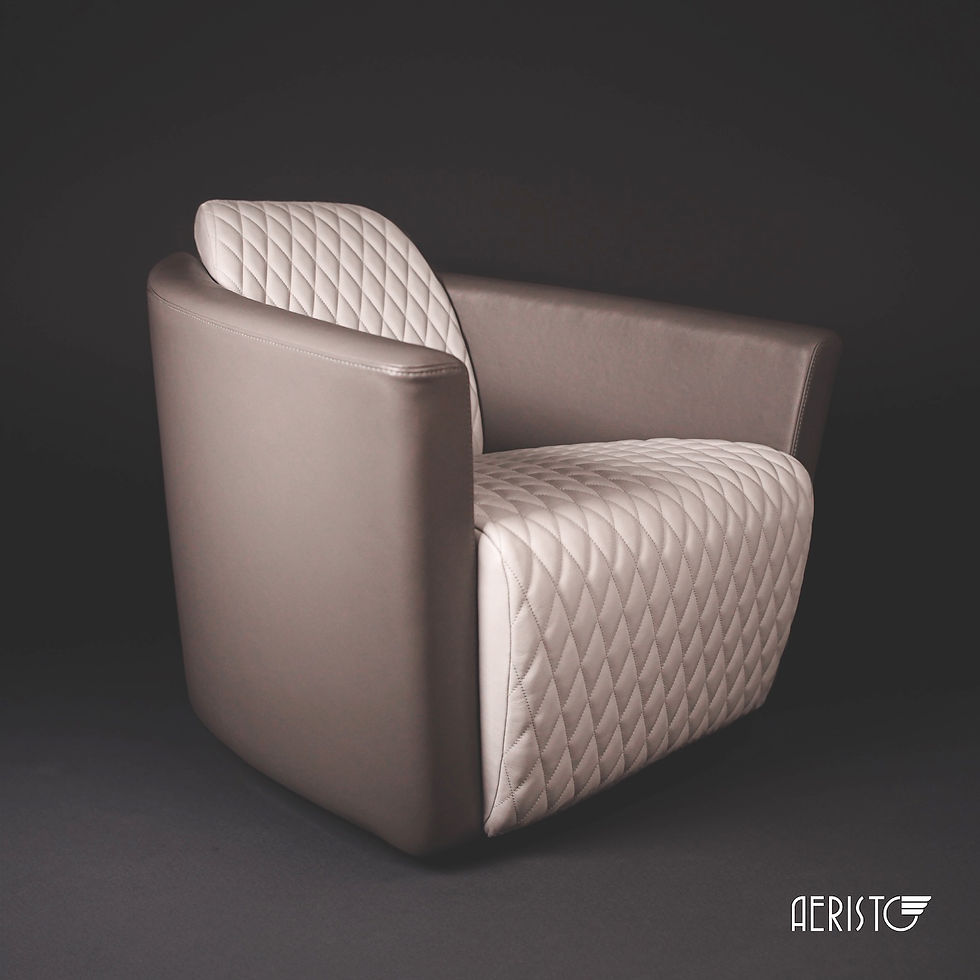
Highly detailed computer guided stitch patters and quilted lumbars are common in today's interiors - and they instantly convey new and fresh

Technology as a Differentiator
Technology has become one of the defining elements of the modern cabin experience. Integrated Cabin Management Systems allow passengers to control lighting, temperature, window shades, and entertainment from personal devices, creating a seamless and intuitive environment.
High-definition displays, immersive audio systems, and real-time flight information enhance both productivity and relaxation. Even the galley has evolved, with advanced equipment enabling a level of in-flight dining that rivals fine restaurants.
Yet technology is also one of the fastest moving aspects of the cabin. Systems that feel cutting-edge today can quickly become outdated, making periodic upgrades essential—not only for usability, but for preserving long-term asset value.
Designing the Interior: Expertise and Strategy
Creating or refurbishing a private jet interior is a complex undertaking—one that blends design vision with engineering precision, regulatory compliance, and long-term asset strategy.
Choosing the Right Partners
Successful projects are built on collaboration among specialized experts.
Completion centers are responsible for engineering, certifying, and installing the interior, ensuring every element meets stringent aviation standards. Design studios bring creative direction, often drawing inspiration from residential and yacht design to elevate the cabin experience. Aircraft manufacturers offer integrated design and completion services, particularly for new deliveries, ensuring harmony between platform and interior.
Equally important are experienced advisors who guide owners through the process, aligning design decisions with operational needs, maintenance considerations, and future resale positioning.
Article by
R I C H A R D R O S E M A N
N
othing starts without a design...and nothing commands our attention like a great one. But a design, like the product of any creative endeavour, is ultimately judged by the pair of eyes looking at it. Yet within the framework of a design competition or an open evaluation conducted by hundreds, or even thousands, it's almost inevitable that one or two designs will find favor, over the others, among a large portion of that audience. Does it mean those designs are better? It's an unanswerable question of course. But it certainly means those few designs are standing out, again and again - above the rest - by those who have been asked to evaluate them.
In this piece, we took a look back at the winners of several globally recognized aviation design competitions - and selected some of our own favorites to show as some of the "best of the best" designs, by some of the top interior architects and designers over 2025.
We hope you like our internally curated selection of interior cabin concepts. We recognize your own preferences may not align with ours completely - but certainly we can all agree that beautiful design is a remarkable thing to behold - and always worth a second look!
Jet Cabin Freshbook LLC - A Jet Media company
All rights reserved

Productivity at Altitude
For many owners, the aircraft is more than a mode of transport, it is a fully functioning workspace. Modern interiors are designed to support productivity at the highest level, integrating advanced connectivity and thoughtful spatial planning.
High-speed satellite internet enables seamless video conferencing and real-time collaboration. Conference seating with deployable tables supports in-flight meetings, while sound-dampening insulation enhances focus by reducing cabin noise. Power integration throughout the cabin ensures that devices remain operational throughout the journey.
Aircraft such as the Dassault Falcon 8X exemplify this versatility, offering multiple cabin zones that allow passengers to work, dine, and rest simultaneously creating a fluid, multi-purpose environment tailored to the demands of modern business.
Passenger Experience and Wellbeing
As private aviation continues to evolve, passenger wellbeing has become a central focus of cabin design, particularly on long-haul missions.
Advancements in pressurization systems now allow cabins to maintain lower effective altitudes, reducing fatigue and improving overall comfort. Circadian lighting systems adjust color temperature to align with natural sleep cycles, while HEPA filtration and rapid air exchange systems ensure a consistently clean and refreshing cabin environment.
Large panoramic windows introduce natural light, reducing the sense of confinement and enhancing the psychological experience of flight. Ergonomically designed seating and lie-flat sleeping arrangements further transform long journeys into restorative experiences rather than endurance exercises.
The Emotional Dimension
Beyond performance metrics and financial consideration lies a more intangible truth: the interior is where the aircraft becomes meaningful.
Maintaining Privacy and Security
For clients who are heads of state, royal family members, or public figures, security and privacy concerns add another layer of complexity. Although it’s rare for your run-of-the-mill billionaire, head-of-state aircraft often incorporate sophisticated defense systems, secure communications, and sometimes even medical facilities—all without compromising the aesthetic experience. Information security during the design and completion process itself becomes crucial, with industrial espionage and security threats requiring strict protocols for all involved parties. This may not apply to you if you’re moving from a Gulfstream or Global into your first large cabin aircraft – but they are considerations depending on your own security needs.
The Delicate Balance
The art of VVIP aircraft design and completion ultimately comes down to balancing competing priorities: luxury versus weight, innovation versus certification, customization versus timeline, opulence versus functionality and convenient fit versus ergonomics. The most successful projects maintain a clear hierarchy among these priorities based on client preferences while establishing transparent processes for resolving inevitable conflicts.
For those fortunate enough to work in this rarefied segment of aviation, the challenges are substantial, but the rewards are equally significant. There are few greater professional satisfactions than watching a "green" aircraft—essentially an empty metal tube painted with green primer—transform into a flying masterpiece that will transport you and your family safely, comfortably, and beautifully around the globe for decades to come. In this elite world where engineering precision meets artistic vision, both the joys and pitfalls are magnified. The projects may be complex, demanding, and occasionally frustrating, but the end results—magnificent flying environments that represent the absolute pinnacle of human craftsmanship and technical achievement—make the journey worthwhile for all involved. “One of the greatest feelings as a completion manager is to present the client with their freshly completed private jet, walking around the aircraft to capture the livery design and then, for the first time, introducing them to their new cabin. As Tom Chatfield gleefully points out, "The smiles, the nods and the joy that can be felt is, unique, and makes those long days, collaborating to find solutions to complex problems, all the more worthwhile.”
Branson’s Chainsaw and the Power of Staying the Course
For the public launch of the Upper Class concept, Branson didn’t do a press release. He came on stage in a gold ice-hockey mask and revved up a chainsaw, then proceeded to demolish a mock British Airways business class seat in front of a live audience. Then the Curtains fell. When they came back up, Design Q’s fully illuminated mockup made it’s debut! The press went in…and the photos went global.
Then September 11th happened.
Three years into the program, the world stopped flying. Every airline froze investment overnight. Design Q, which had felt protected by its dual presence in both automotive and aviation, suddenly found itself staring into the same abyss as everyone else. But Branson, to his considerable credit, kept writing cheques.
“He knew that if they stopped the program, they would likely never come back to it,” Guy says. “So he kept putting money in the machine.” By the time the industry began to recover in 2003, Virgin was the only carrier with something genuinely new to show. Every other airline was starting from scratch. Virgin was already finished. “We launched when everybody else was back at the starting gate,” Guy says. “Which was just genius.”
The lesson wasn’t lost on Guy. In a business where everyone defaults to caution when things get turbulent, the boldest move is sometimes to simply keep going.

By Richard N. Ziskind
Photo by: Jerry Wyszatycki
.png)
Article by
R I C H A R D R O S E M A N
N
K, so picture this: You've just shown up at the completion center to take delivery of your $85ML state-of-the-art business jet with an avionics and connectivity package that would make SpaceX jealous, plus enough range to fly non-stop to almost anywhere your heart desires. You step aboard your freshly minted jet and spy the beautifully upholstered VIP seats with the Italian leathers and plated metal trims you chose months earlier with your designer.
But over the course of the next hour or so, as you sit in your chair anticipating the maiden flight back home, an ever so slight, and not entirely unfamiliar disappointment, begins to tug at you. Why is it that after all these decades, four previous aircraft, and stratospheric costs, the seat's comfort still falls way short of what you enjoy at home? Instead, both the rigid profile and the comfort feels like it was designed during the Reagan administration—because, quite possibly, it was.
Welcome to one of aviation's most puzzling paradoxes: Why do VIP aircraft seats lag so dramatically behind the ergonomic marvels we enjoy in our living rooms, offices, and even our cars? It's a question that haunts aircraft owners, frustrates completion centers, and keeps chiropractors in business from Teterboro to Dubai.
othing starts without a design...and nothing commands our attention like a great one. But a design, like the product of any creative endeavour, is ultimately judged by the pair of eyes looking at it. Yet within the framework of a design competition or an open evaluation conducted by hundreds, or even thousands, it's almost inevitable that one or two designs will find favor, over the others, among a large portion of that audience. Does it mean those designs are better? It's an unanswerable question of course. But it certainly means those few designs are standing out, again and again - above the rest - by those who have been asked to evaluate them.
In this piece, we took a look back at the winners of several globally recognized aviation design competitions - and selected some of our own favorites to show as some of the "best of the best" designs, by some of the top interior architects and designers over 2025.
We hope you like our internally curated selection of interior cabin concepts. We recognize your own preferences may not align with ours completely - but certainly we can all agree that beautiful design is a remarkable thing to behold - and always worth a second look!



Article by
R I C H A R D N. Z I S K I N D
Chief of Staff to the Board of Directors @ Alerion Aviation
JCF Magazine Special Contributor
private jet is often defined by its performance—range, speed, and engineering precision. Yet its true value is not measured at altitude but experienced within the cabin. It is here that the aircraft becomes personal, where utility transforms into experience, and where the asset assumes both tangible and intangible worth. The interior is, unequivocally, the heart and soul of the aircraft.
"This is where value becomes tangible."
In today’s market, a thoughtfully designed and well-maintained interior is not merely an aesthetic asset, it is a financial one. A modernized cabin can significantly elevate an aircraft’s market position. Refurbished interiors in large-cabin jets such as the Gulfstream G650 or Bombardier Global 7500 routinely command multimillion-dollar premiums over comparable aircraft with dated finishes.
A
Article by
R I C H A R D N. Z I S K I N D
Chief of Staff to the Board of Directors @ Alerion Aviation
JCF Magazine Special Contributor
private jet is often defined by its performance—range, speed, and engineering precision. Yet its true value is not measured at altitude but experienced within the cabin. It is here that the aircraft becomes personal, where utility transforms into experience, and where the asset assumes both tangible and intangible worth. The interior is, unequivocally, the heart and soul of the aircraft.
"This is where value becomes tangible."
In today’s market, a thoughtfully designed and well-maintained interior is not merely an aesthetic asset, it is a financial one. A modernized cabin can significantly elevate an aircraft’s market position. Refurbished interiors in large-cabin jets such as the Gulfstream G650 or Bombardier Global 7500 routinely command multimillion-dollar premiums over comparable aircraft with dated finishes.
A




Winning Bombardier — Against Ferrari. Against Porsche. Against Mercedes
By the mid-2000s, Design Q had added Cathay Pacific to its portfolio and built out a certified aviation trim shop. When Bombardier came looking for a consultancy to redesign the flight deck of their Global XRS business jet, they were seeking firms with automotive experience and sensibilities. They targeted five: Design Q, and the design studios of Ferrari, Porsche, Maserati, and Mercedes-Benz.
Not exactly a fair fight, on paper. But Design Q had something the others didn’t: they’d actually done it before. They were steeped in automotive to be sure - but their feet were now wet in aviation.
Guy’s pitch was audacious. He told Bombardier he wanted to change the flight deck from its standard cold military blue-grey to a warm grey — “Bentley expensive,” as he put it, rather than “cold, uninviting military.” The response from certain Bombardier engineers was predictably enthusiastic: “Absolutely not. Certification. Multiple suppliers. Three or four years.” The usual aviation hurdle course (a.k.a. corporate excuses).
Then something unusual happened. An email arrived from a Bombardier senior figure named Grant Partridge — who, as it turned out, had attended exactly the same university as Guy, in exactly the same industrial design programme, finishing in 1978 just as Guy was arriving to take his seat in the same lectures. “What are the chances,” Guy recalls. “It was serendipitous.”
The connection gave Guy a foothold, if only psycological. And when the proposals were all laid out on a table — including a last-minute re-submission from Bombardier’s own in-house design team, who had been told their first effort wasn’t good enough — it was Design Q’s renders and animations that Bombardier’s team agreed was the most extensive, the most realistic and the likely the most buildable.
So, what happened? The other agencies were let go. So too, albeit quietly, was their in-house studio.
“We’d won it,” Guy says, “but we didn’t realise they’d just fired everybody in the blinking studio.”
"Worn upholstery, outdated palettes, or legacy cabin management systems can quickly erode perceived value, even in otherwise well-maintained aircraft."

Leather Yokes, Sheepskin Seats, and a Hug from the President
The Global Vision Flight Deck project that followed is, by any measure, a Design Q highlight reel. Everything was redesigned from first principles, with an automotive lens. The Yoke — historically a cast aluminium-and-nylon affair across the industry — was reborn as a hand-stitched, leather-wrapped yoke with double stitching and a central boss, looking for all the world like a luxury steering wheel.
“When you see the yoke, that’s where your focus is,” Guy says. “Because it’s double-stitched. It’s got a boss in the middle. It’s starting to look a million dollars. And they freaked out.” In a good way, he adds.
The pilot seats were trimmed in carefully patterned sheepskin — not the saggy elastic-stretched seat covers that had been the industry norm, but precision-patterned, CNC-machined, properly manicured sheepskin with controlled thickness and temperature regulation. Carbon fibre appeared on the grab rails. The cold, utilitarian grey gave way to a rich, warm tone that made the cockpit feel, as Guy had sold, like stepping into a Bentley.
The unveiling at the NBAA Atlanta convention was a triumph. Pilots loved it — this was, after all, their space — and Bombardier’s president, who had seen almost nothing of the project beforehand (the whole thing had been kept to a circle of six people), viewed the Full size nose section of the Global, boarded the steps and viewed the new Global Vision Flight Deck. His smile said it all!
For Guy, a man whose studio had competed against Ferrari & Porsche design and won, this ranked as, well…a moment to remember! Something to be proud of.
“And that’s the buzz of it,” he concludes.
Continue this article below...
Story by: Melissa Tokoriyama
Special Features Contributor

Image by: Business Jet Interiors Magazine
N A V I G A T E / E X P L O R E
As with most winners, clean lines and minimalistic themes continued to dominate througout the 2025 awards season. Voltare's entry is a good example of clean, uncluttered design - the stylistic preference of most owners today.

Continued Below...
A modernized cabin can significantly elevate an aircraft’s market position. Refurbished interiors in large-cabin jets such as the Gulfstream G650 or Bombardier Global 7500 routinely command multimillion-dollar premiums over comparable aircraft with dated finishes.


Key Considerations
Every decision within the cabin has broader implications.
The layout must reflect the aircraft’s mission—whether global business travel, leisure, or a hybrid of both. Material choices must balance aesthetics with weight, durability, and performance impact. Certification requirements introduce an additional layer of complexity, as every component must meet rigorous safety standards.
Technology integration must be forward-looking, allowing for upgrades as systems evolve. Maintenance considerations are equally critical, as highly customized or delicate elements can increase downtime and long-term cost.
Finally, there is the question of resale. While personalization enhances the ownership experience, overly niche design choices can limit future market appeal. The most successful interiors strike a balance—distinctive yet broadly desirable.
Lifecycle and Asset Management
Unlike the airframe or engines, the interior is a dynamic component of the aircraft—one that evolves over time. Refurbishment cycles typically occur every five to ten years, ranging from soft updates to complete redesigns.
Well-executed refurbishment programs do more than refresh aesthetics. They protect long-term value, enhance marketability, and ensure the aircraft remains aligned with current design and technology standards. In the resale market, aircraft with recently upgraded interiors consistently outperform those with original or aging cabins.
The Emotional Dimension
Beyond performance metrics and financial consideration lies a more intangible truth: the interior is where the aircraft becomes meaningful.
It is where business decisions are shaped, where families share time together, and where moments of quiet reflection unfold above the clouds. This emotional connection cannot be quantified, yet it often defines how owners perceive the true value of their aircraft.
In private aviation, performance defines capability—but the interior defines experience, value,
and ultimately, the soul of the asset.


JCF Magazine is honored to have had Richard Ziskind make this editorial contribution to our May issue.
Richard is one of the most renowned and respected voices in our industry. His above words focus on the most important and consequential aspects of today's jet interiors...the things that truly matter, not only within its life with the owner, but in positioning that ownership to maximize resale when the time comes.
In all of Mr. Ziskind's articles, he provides unique and sage advice to owners, operators, and flight departments, speaking both to the flight experience itself and the peripheral aspects of ownership. We hope Richard will continue to draw on his experience and offer more articles for our readers in coming issues.

%20copy%204.png)

“The performance of a private jet may define its capability, but the interior defines its true value. It is where the aircraft becomes personal—shaping both the passenger experience and the perception of the asset. Ultimately, the cabin is where engineering gives way to experience, and where the aircraft finds its soul.”


Fontainebleau Aviation







By: M a t t h e w B r e n n e r
Special Features Contributor
I.A.L.D.
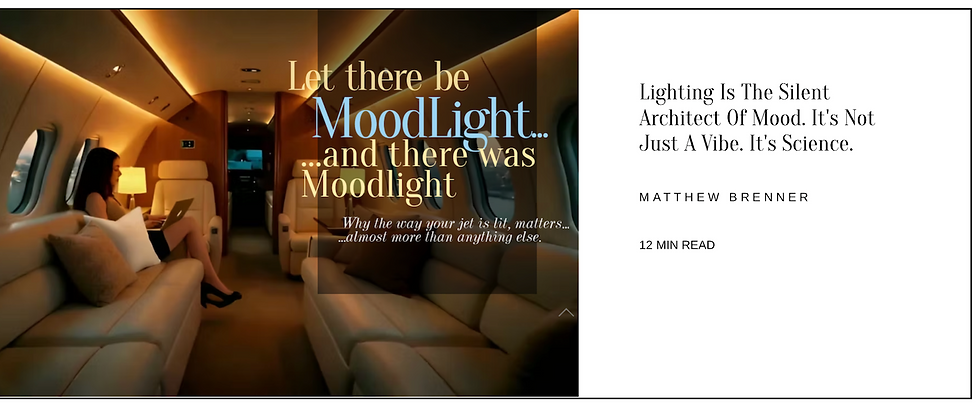
Let’s be real for a second. You didn’t spend eight figures on a private jet to sit in a cabin that looks like a fluorescent-lit conference room in the sky. The whole point of traveling privately is the experience — the feeling. And nothing — not the leather, not the cashmere throw, not even the bespoke bar stocked with your favorite single malt — shapes that feeling more profoundly than light.
Lighting is the silent architect of mood. It’s the difference between feeling like you’re on a luxury escape and feeling like you’re being interrogated. At 45,000 feet, where the outside world is a cold black void dotted with stars, what happens inside your cabin becomes the entire world. So yes, the lighting better be extraordinary.
The world of VVIP large cabin aircraft design represents the pinnacle of luxury aviation, where engineering brilliance meets artistic vision to create flying palaces for heads of state, royal families, and ultra-high-net-worth individuals. These extraordinary aircraft combine cutting-edge technology with exquisite craftsmanship, creating spaces that must function flawlessly at 40,000 feet while rivaling their owner’s homes and yachts back on earth. Yet for all its glamour, the process of designing and completing these magnificent machines is fraught with challenge and the inevitable pain that comes with it. In this article, we explore both the sublime joy and the formidable pitfalls of bringing these elite flying environments to life.
And in the end, we show you how to avoid most, if not all of it, via keen awareness and a couple of smart decisions before jumping in.

A D D I T I O N A L D E P A R T M E N T S & R E S O U R C E S
C A B I N S U P P L I E R S - W O R L D W I D E
Supplier + contains more than 400 of the top cabin supplier groups around the world. 48 separate categories broken into Design & Technical disciplines. Supplier + is stands as the most comprehensive, fully managed roster in the industry


G L O B A L D E S I G N S T U D I O R O S T E R
Global Design Roster is the world's only managed listing of the top aviation interior designers and architects in the industry, globally. GDR includes not only the renown independents, but the top design chiefs of major completion centers.

C O M P L E T I O N C E N T E R S ( G L O B A L)
Without completion centers, none of the beautiful designs would ever see the light of day. We've compiled a comprehensive global listing of the world's top centers - all for you in helping to source just the right asset for your next project

O W N E R / O P E R A T O R S
NEW!
Brand new, exclusively for our Owner / Operators and Flight Departments. Offering valuable Resources including Shard Articles, Lifestyle, Destinations and our own curated assemblage of Luxury accoutrement from the top brands in the world.

There is nothing quite as relaxing as the whisper of twin Rolls-Royce BR-700 jet engines at cruise, looking down on a thick layer of buttermilk clouds painted in the soft glow of the moon's reflected light.
The only way that gets any better, is to have the cabin's lighting scene dialed into the very same vibe. When it's right, it approaches nirvana.



LED: The Revolution Nobody Saw Coming
Twenty years ago, the aviation lighting world was stuck in a distinctly unglamorous rut. Halogen and fluorescent fixtures ruled the cabin. They were hot, they burned out constantly, they guzzled power, and — this is the part that should make any design-conscious owner shudder — they offered exactly zero ability to dim, tune, or transform. What you saw was what you got. And what you got was… fine. Just fine. Terrible, actually.
Then came LED, and the whole game changed overnight. Modern aircraft-grade LED systems run cooler, consume dramatically less power (important when your cabin entertainment systems and galley equipment are competing for electrons), and last for tens of thousands of hours. But the real magic isn’t longevity or efficiency. The real magic is tunability.
Today’s LED fixtures in premium jets can slide across the full visible spectrum with buttery precision. They can go from a blazing 6500K daylight to a smoldering 1800K fire-pit glow. They can blush rose gold for a dinner party at 39,000 feet. They can pulse a gentle violet that honestly has no business being as chic as it is. (Please don’t overuse the violet. You know who you are.)

Dial in your MOOD.
T H E M A G A Z I N E
M A I N P A G E
You'll find all of JCF Magazine's primary content right here on our main page. From day one, we sought to put all of our current "issue to issue" stories and features all on the same page. Why? Because it requires no thumbing or linking to other pages to see all of the latest issue. Our subscribers love it and so will you! So for all the newest articles, news, features, ads and more, look no further than our main page
Just scroll, read, discover and enjoy!
“The right light at altitude doesn’t just set a mood — it rewires how your brain processes the journey. It’s the difference between arriving depleted and arriving luminous.”


Lighting Scenes: Your Cabin, Your Rules
The concept of a “lighting scene” is essentially a saved preset — a curated combination of intensity, color temperature, and zone activation that you can summon with a single tap. Think of it as a Spotify playlist, but for the atmosphere of your aircraft. Your integrator programs them in advance; you trigger them on demand via tablet, touchscreen, voice command, or increasingly, AI-driven automation that reads the room and makes adjustments without being asked.
A typical luxury configuration might include something like this:
Pre-Departure
Bright, neutral whites. Cabin awake and functional. Everyone can see what they’re doing.
4500K — 100% intensity
Cruise & Relax
Warm amber wash, dimmed perimeter strips. Conducive to reading, conversation, unwinding.
2700K — 55% intensity
Dinner Aloft
Candlelight-adjacent warmth, table-focused down-lighting. Michelin-star energy, 40,000 feet up.
2200K — 40% intensity
Sleep Mode
Near-darkness with the softest warm bias glow at floor level. Melatonin-friendly. Circadian-aware.
1900K — 8% intensity
The best systems today — from brands like Astronics, Diehl Aviation, and boutique integrators like Lufthansa Technik’s VIP division — layer these scenes with geo-awareness. The cabin literally knows where you are in the world and what time it is at your destination, autonomously dialing in the most circadian-friendly environment to help you land ready, not wrecked. That’s not sci-fi. That’s Tuesday in the Gulfstream G700.

VIP large cabin private aircraft represent both the pinnacle of ownership and complexity.

J O S E P H B U R N S

bright, blue-enriched light (like sunlight) in the morning to boost alertness and dim, warm-toned light (red or amber) in the evening to facilitate melatonin production.

.png)


R E C U R I N G S E G M E N T S


You'll find all of JCF Magazine's primary content right here on our main page. From day one, we sought to put all of our current "issue to issue" stories and features all on the same page. Why? Because it requires no thumbing or linking to other pages to see all of the latest issue. Our


You'll find all of JCF Magazine's primary content right here on our main page. From day one, we sought to put all of our current "issue to issue" stories and features all on the same page. Why? Because it requires no thumbing or linking to other pages to see all of the latest issue. Our

%20(1).png)
You'll find all of JCF Magazine's primary content right here on our main page. From day one, we sought to put all of our current "issue to issue" stories and features all on the same page. Why? Because it requires no thumbing or linking to other pages to see all of the latest issue. Our
All right here on our main page - each and every issue
Color Temperature. The Dial Nobody Talks About
Here’s a concept that separates the aviation design pros from the amateurs: color temperature. Measured in Kelvin (K), it determines whether your light feels like a blazing noon sun or a warm candle flickering on a mahogany table. Most people never consciously think about it. On the other hand, every great lighting designer thinks about almost nothing else.
For private jet cabins, the magic zone tends to live between 2200K and 3000K in the evening hours — that honeyed, amber-kissed warmth that makes everyone look like they have a permanent glow-up. It’s flattering. It’s relaxing. It whispers “you’ve arrived” without saying a single word. Bump it up to 4000K or 5000K for the morning departure, and suddenly the cabin snaps to attention — crisp, focused, ready for that pre-landing briefing.

TECH SPOTLIGHT: Latest LED Innovations in Top-Tier Private Jet Builds
-
Micro-OLED ceiling panels that replicate natural sky transitions, including sunrise and sunset sequences timed to your destination time zone
-
Circadian rhythm programming — automatically adjusting temperature and intensity to prepare your body clock for landing
-
Haptic-responsive surfaces that shift color temperature in response to cabin noise levels or passenger heart rate (via wearables integration)
-
Addressable LED strips embedded invisibly in sill rails, crown panels, and cabinetry with sub-millimeter precision
-
Quantum dot LED technology delivering unprecedented color accuracy across a CRI of 98+ (essentially indistinguishable from natural light)


T H E C E N T E R S
Another first for JCF Magazine. THE CENTERS is a brand new permanent resource with its own dedicated page. A comprehensive listing of the top completion centers - worldwide - plus additional independent completion management resources to help owner / opearators and private flight departments make iformed decisons.
Image courtesy VIP Completions
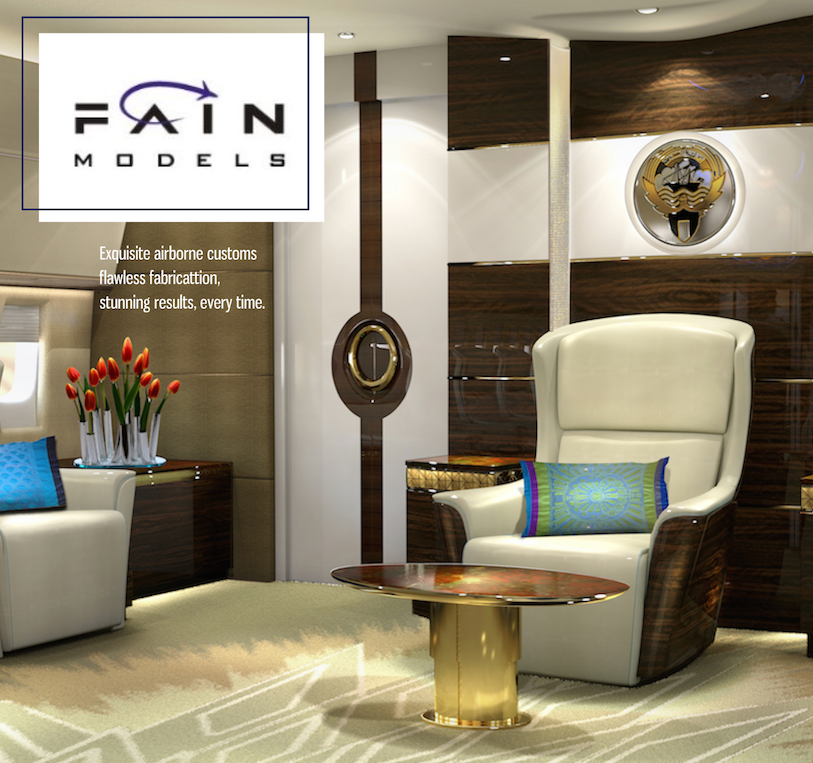


Courtesy of: Collins Aerospace
Aircraft LED lighting assemblies come in just about every shape and size imaginable - and what all of them have in common is that they can be controlled across the entire visible color temperature spectrum and brighness.
But of course the big win is that they produce essentially no heat and outlast incandescent or halogens by 25 times - an average of 50,000 hours.




The Evening Hours: Where the Magic Is
If there’s one time of day when aircraft lighting truly separates the extraordinary from the merely expensive, it’s the evening flight. As darkness gathers outside and the cabin becomes a sealed world of its own, every photon matters. The way the warm light catches the stitching on a bespoke leather chair. The way an indirect cove-lit ceiling transforms a fuselage into a sanctuary. The way a well-programmed transition from dinner scene to sleep scene feels less like a setting change and more like the world itself slowing down for you.
This is the alchemy that great lighting design achieves. It’s not decoration. It’s not a luxury add-on you can skip to save weight. It’s the invisible framework that holds the entire experience together. Get it wrong, and no amount of Italian marble flooring or custom-milled cabinetry will save you. Get it right, and your passengers won’t be able to explain why the cabin feels so impossibly good — why the vibe is so spot on. They’ll only know that it does.
In an industry where every detail is scrutinized and every gram of weight is justified, lighting remains one of the highest-ROI investments you can make. It transforms a tube of aluminum hurtling through the stratosphere into something that genuinely feels like a destination in its own right.
_________________________________________
Light it well. Light it thoughtfully. And for the love of all that is tasteful — please program those scene transitions with a slowwww fade. Nobody needs a mood change that snaps like a gymnasium overhead coming on at full blast. You’re not at a concert. You’re at 45,000 feet. It's evening. Dial in your vibe!


In 2003, to promote Virgin Atlantic's new upper-class luxury services (specifically the world's longest fully flatbed), Richard Branson wore a hockey mask and wielded a chainsaw to cut up airplane seats, symbolizing his efforts to "cut down" the competition.
It was part of his aggressive, often humorous, marketing tactics against his main rival, British Airways, in the early days of Virgin Atlantic.
“In a car studio, you come up with a concept and then you have to show what it looks like pretty quickly,” Guy explains. “You’ve basically got to build a show car. And everything is driven by program timing.” That mentality — sign-off first, questions later — would serve him unexpectedly well in the world of commercial aviation.
Design Q’s first major aviation didn’t know where we were going — which is the fun.”
The fun, as it turned out, included airbags. Not on the runway. On the seats. When Virgin’s famously rule-averse young team asked why you couldn’t put airbags in aircraft the way cars had them, most people in the industry would have chuckled and moved on. Guy’s team said: “Let’s figure it out.” Virgin Atlantic became the world’s first airline to fit airbags in the main cabin. Which is either a testament to what happens when car people and aviation dreamers collide — or proof that Richard Branson will greenlight almost anything if you frame it correctly.
commission arrived via a party invitation. Literally. Guy had thrown a launch event for a sports car the studio had been working on, and Virgin Atlantic executives turned up. They saw the car, loved the craft, and came back with a question that would change everything: “Can you build something for us?


M A Y F E A T U R E D D E S I G N S T U D I O


“ On the Virgin project, Nobody knew what the interior was going to be,” Guy recalls with a grin. “We didn’t know what it was going to be - which is the fun part!
Design Q also ended up as co-patent holders on the original Upper Class suite — Virgin’s signature hybrid between first and business class. The original brief had been simply to produce a concept. But because Design Q had a habit of actually building things, one concept led to a mockup, the mockup led to a full 38-foot cabin section of a 747, and that cabin section was so convincing it reportedly still appears on Virgin’s official website today. “That was 2003,” Guy notes. “And it’s our model.”

The Unrivaled Joy of Creating an Airborne Home
“Unlimited Creative Canvas” perhaps the greatest thrill in VVIP aircraft design is the vast creative freedom afforded by clients with exceptional resources. Where commercial aircraft prioritize passenger capacity and operational efficiency, VVIP projects elevate form alongside function. Designers work with rare woods like Macassar ebony, delicate mother-of-pearl inlays, hand-stitched leathers, and custom forged precious metals. Master artisans spend thousands of hours crafting one-of-a-kind environments, from hand-painted cloud motifs on ceilings to bespoke furniture pieces that could easily grace the world's finest residences.
Technological Innovation
VVIP aircraft often serve as laboratories for aviation innovation. The most sophisticated cabin management systems allow passengers to control lighting, temperature, entertainment, communications, and privacy features through intuitive interfaces. Advanced sound dampening technologies create whisper-quiet cabins despite the roar of engines just outside the cabin. High-speed connectivity ensures that business and communication continue seamlessly across continents. And as sustainability becomes increasingly important, innovative solutions for reduced emissions and more eco-friendly materials are finding their way into these elite aircraft.
Creating Multi-Functional Spaces
The spatial transformation of a large cabin aircraft presents fascinating design challenges. A single Boeing 787 or Airbus A350 must serve as office, dining room, bedroom, entertainment space, and sometimes even medical facility—all while adhering to stringent safety regulations. The joy comes in creating ingenious solutions: conference rooms that transform into formal dining areas, walls that shift to reconfigure spaces, and furniture engineered to provide comfort during long-haul flights while meeting safety and emergency requirements. Every square inch must serve multiple purposes without compromising luxury or functionality.


Concept : DE LUSSAC Studio

Add paragraph text. Click “Edit Text” to update the font, size and more. To change and reuse text themes, go to Site Styles.
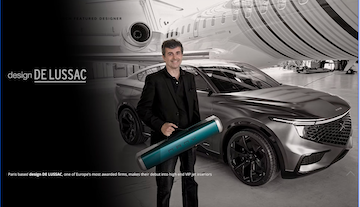
Founded in 2000 by Thomas de Lussac, De Lussac Design Studio is a multidisciplinary agency renowned for its innovative and elegant creations in automotive, furniture, luxury goods, and high-tech fields. Multi-awarded internationally, the studio delivers creative solutions blending innovation, functionality, and aesthetics.
Over the past year, the studio has expanded its scope with the launch of a dedicated aviation design division, focusing on private jet interiors and advanced mobility concepts. This evolution reflects a natural extension of its expertise, applying its rigorous design approach to the highly demanding world of aviation.
With more than 300 projects completed for prestigious clients, De Lussac Design Studio has developed a distinctive methodology where design is approached as a system rather than an isolated object. Each project is defined by a careful balance between technical precision and refined simplicity, with particular attention to materials, proportions, and user experience.
From mobility to bespoke interiors, the studio explores design as a means to anticipate new ways of living and moving, shaping contemporary objects with a clear and enduring vision.
Add paragraph text. Click “Edit Text” to update the font, size and more. To change and reuse text themes, go to Site Styles.
Add paragraph text. Click “Edit Text” to update the font, size and more. To change and reuse text themes, go to Site Styles.

Photo: Leopold Fiala -leopoldfiala.com
Design is not decoration. It is a strategic tool to shape growth and define the future
T H O M A S D E L U S S A C

Concept : DE LUSSAC Studio

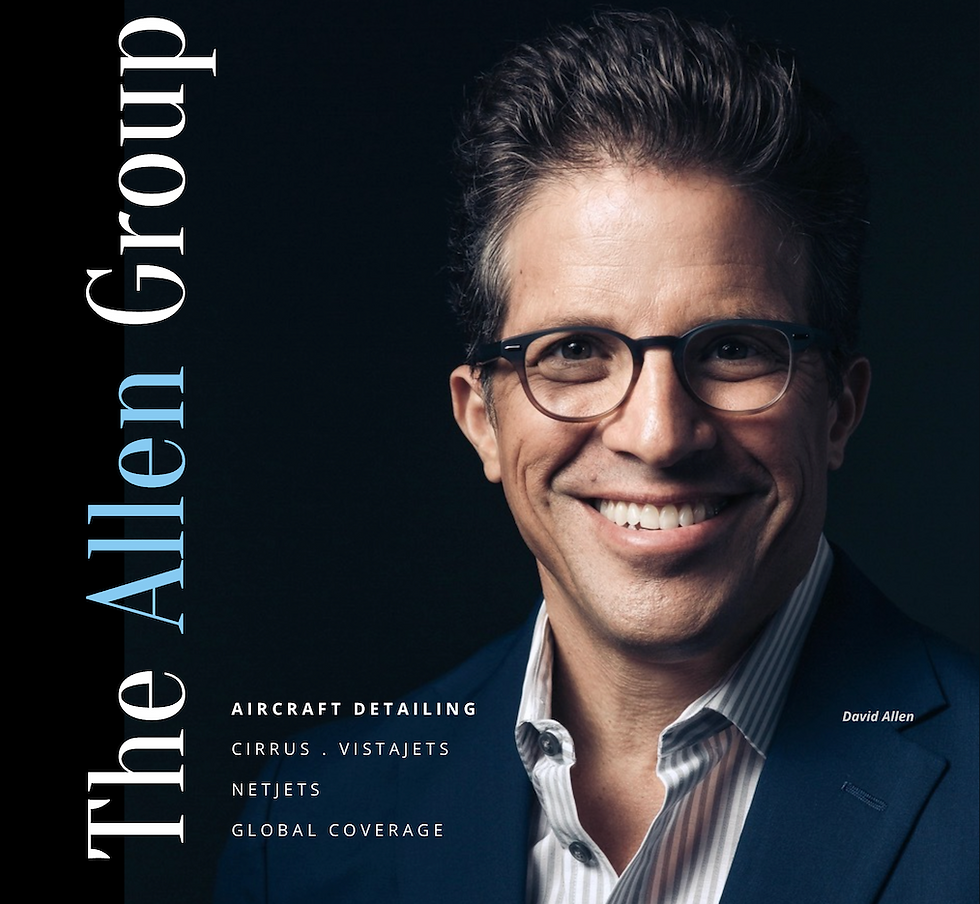
There are origin stories, and there are origin stories. David Allen’s begins in Speedway, Indiana, a town whose name alone tells you something about its priorities, where he grew up in the shadow of the Indianapolis Motor Speedway. His high school mascot was the Spark Plugs. A character named Sparky jogged around the football field. It was, by his own admission, a little embarrassing.
But that quirky Midwestern upbringing planted the seed for one of the most quietly impressive entrepreneurial journeys in general aviation. Today, David is the founder of The Allen Groupe, a premier aircraft detailing and cleaning company that at its peak spanned 37 locations in the United States and 16 in Europe, counting NetJets, VistaJet, Cirrus Aircraft, and JSX among its most prominent clients.

“The hardest stain to get out is a water stain,” he says. “Just think about that.”
A Teenage Hustle with Legendary Customers
At 15 or 16 years old, most kids are figuring out their weekend plans. David Allen was figuring out payroll. He launched a mobile wash and detailing business while still in high school, and his proximity to the Speedway meant his earliest clients were anything but ordinary. He found himself washing motorhomes and vehicles for the likes of AJ Foyt, Mario Andretti, Rick Mears, Johnny Rutherford and the Unsers, Big Al, Bobby, and Little Al, a true who’s who of motorsport royalty.
He got that kind of access through a connection with the Hulman-George family, the dynasty that owned and operated Indianapolis Motor Speedway for decades.
“I grew up with the Hulman-George family,” David recalls. “They helped me get my credentials to go to other race tracks.” He got to know the legends personally, including the notoriously gruff AJ Foyt, who turned out to be something of a surprise. “He seemed very aggressive in public settings and in front of the media,” David says with a grin in his voice. “He had this big bark. But, in reality, he was a teddy bear, a prince of a guy.”
By 16, David had employees of his own and was traveling across the country. The entrepreneurial bug had bitten hard.
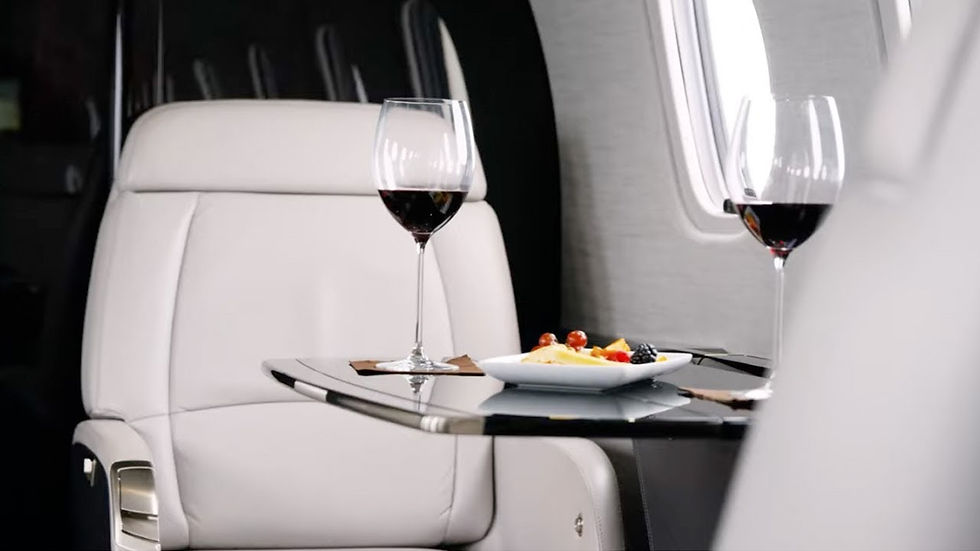
”There is nothing more stunning to look at than an all-white interior. Unfortunately, that's about all it takes to dirty and stain them."
From Racetracks to Runways
After studying at Indiana University, David kept the mobile wash business going, but a new obsession was taking hold. He had always wanted to be a pilot. And as it turned out, his detailing clients were increasingly aircraft owners.
One customer had a Beech Bonanza. The next had an MU2 and the third owned and flew a Beechcraft Starship. This lead to taking care of a demo fleet of King Airs. A seasoned demo pilot on that account, “a tough old bird,” as David fondly describes him, pushed David to raise his standards significantly. Aviation detailing, it turned out, was a world unto itself: technically demanding, unforgiving of shortcuts, and full of clients who noticed everything.
The pivotal moment came when David submitted a bid to NetJets, at the time one of the fastest-growing fractional ownership companies in the world. He was invited to Columbus, met the leadership team, and landed the account. What followed was a period of rapid expansion: Orlando, then Atlanta, then across the country, until The Allen Groupe represented a remarkable 71% of NetJets’ entire cleaning budget. Then came another invitation by NetJets, Europe.
The Science Hiding in Your Carpet
Ask David Allen about aircraft cleaning and he will not just talk about elbow grease. He will talk about chemistry. Specifically, he will talk about pH, and he will make you realize just how much damage a bottle of household cleaner can do to a $40,000 carpet, or a $2 million interior.
His guiding framework is something he calls TACT: Time, Agitation, Chemical, and Temperature. It is the same set of principles your grandmother applied when doing dishes, hot soapy water, a good soak, some scrubbing, just applied with scientific precision to silk upholstery and wool carpeting worth more per square foot than most people’s furniture.
“When you throw dishes in a dishwasher, it boosts up the heat, adds the cleanser, tries to do some agitation with the jets, but, as we know, it doesn’t always quite get it clean,” he explains.
“Nothing cleans like hand cleaning. Mom is always right.”
“We can make your carpet look 100% better, but that doesn’t necessarily mean 100% back to new. But hopefully I can save you the $40,000 it will take to replace it.”

The DELOS Company - American Made Aircraft Carpet


S H O W C A S I N G T H E W O R L D ' S T O P D E S I G N E R S - A T T H E T O P OF T H E I R G A M E
Image courtesy of Sotto Studios

Heritage Brands have long written the pages of history through fine craftsmanship of the artisan’s hands. Calloused hands that work the anvil and the hammer, hands that love at dusk, and rise again to be used at dawn. Each day brings an awakening, carving a memory of history into centuries yet to be born.
Diamonds and dust of gold are fashioned with Filigree, Guilloché and Engraving on surfaces of steel, leather and porcelain, and within these crafted orifices lay embedded crevices marked with the invisible fingerprints of the artisan.
Such is the nature of the legacy of heritage brands.
Today, Innovation with technology, and our fascination with the outer world stretches our curiosity to bend our minds to understand, visualize, and reimagine the amalgamation of these two dimensions, leading us to craft products that are functional for the digital world, while still honoring the role of the artisan written on
the tactile substrates of the heritage brands.
ARTIFACTS OF CHANGE

Heritage Brands have long written the pages of HISTORY

B L U E O D Y S S E Y
Interior Design Concept, Airbus A350-1000
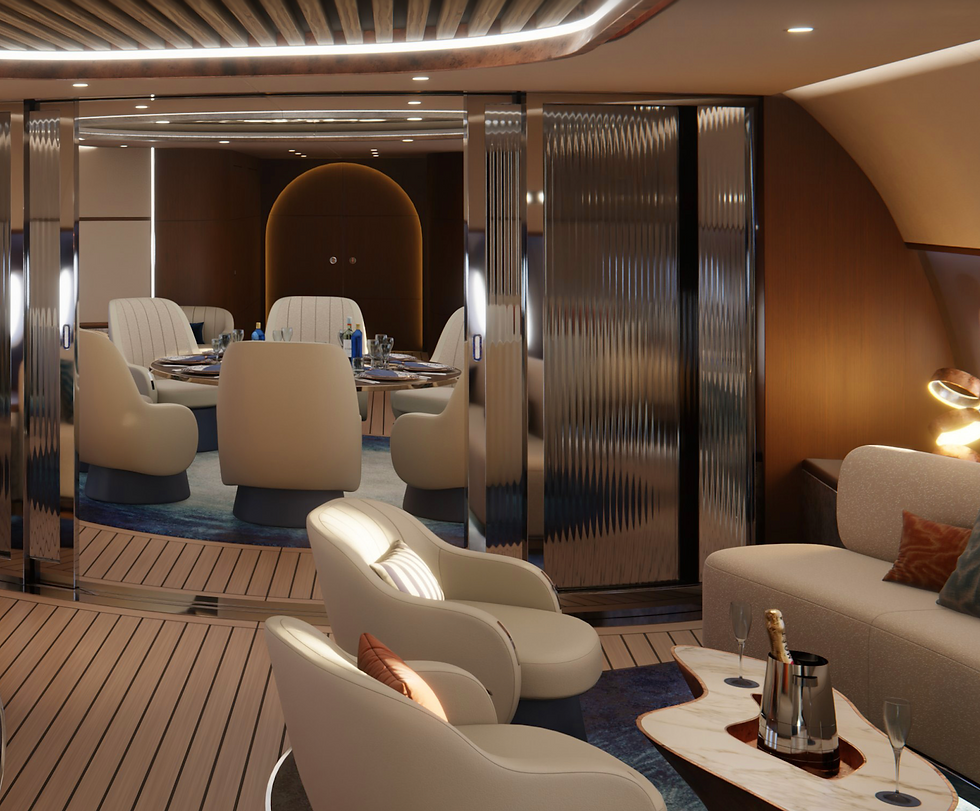
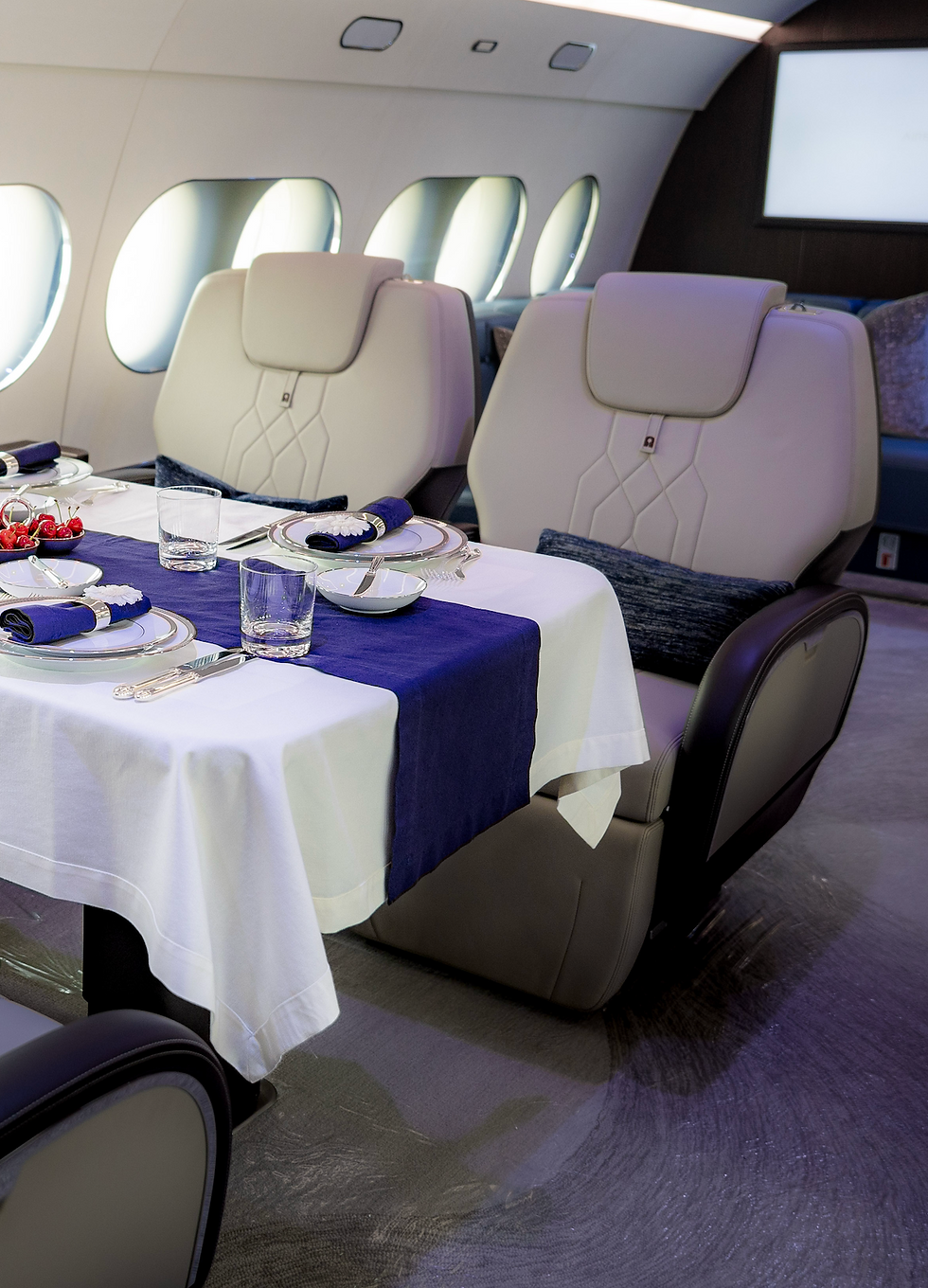
Blue Odyssey is a private jet interior design concept inspired by Homer’s Odyssey, both a reference
to travel and a metaphor for transformation. Like Ulysses’ journey, simultaneously physical and
introspective, the project explores the triple dimension of flight:
- the outward journey across horizons,
- the inner journey toward reflection and renewal,
- and a promenade within the aircraft itself, conceived as a voyage from island to island.
The concept introduces the aesthetics of yachting into long-range private aviation, translating
maritime sophistication into a contemporary and refined airborne architecture. Fluid lines inspired
by classic yachts structure the space and encourage natural circulation. Hand-finished woods,
polished chrome, and sustainable leathers create a timeless material palette, set in dialogue with
the technological precision of the A350.
Blue is one of the project’s defining signatures. Rarely used in private aviation interiors, it becomes
here both a spatial and emotional language. Expressed through deep tones and subtle gradients, it
creates an immersive continuity between sky and sea while conveying confidence, stability, and
serenity, essential qualities in flight.
The cabin is conceived as a mobile sanctuary where each space becomes a port of call. Light,
discreetly modulated, accompanies the journey, and highlights volumes
without ever dominating them.
More than an interior, Blue Odyssey is a spatial narrative where craftsmanship, emotion, and
Innovation converges to transform the private jet into a personal odyssey.

Concept : DE LUSSAC Studio
Design is not decoration.
It is a strategic tool to shape growth and define the future
- T H O M A S D E L U S S A C


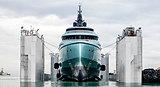

M / Y K E N S H O
%20c.png)
The May 2026 Installment of Jetzign is Proud to Feature
JETZIGN is a ongoing feature in each issue of JCF Magazine,
as well as a permanent section. The purpose of Jetzign is to display the talents, techinical skills and completion oversight expertise of the world's most recognized designers (both the independents and those who preside over the design departments within major centers). Within each Jetzign feature article, we focus on the work of a specific designer and illustrate the body of their work via video animation, still images and narratives from the designer.
T H O M A S D E L U S S A C
Design De Lussac - Paris
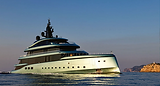
Kensho is a 75.18 m Motor Yacht, built in Italy by Admiral -
The Italian Sea Group and delivered in 2022.
Her top speed is 15.9 kn, her cruising speed is 13.6 kn, and she boasts a maximum cruising range of 4500.0 nm at 13.0 kn, with power coming from three Caterpillar diesel electric engines. She can accommodate up to 16 guests in 8 staterooms, with 20 crew members. She has a gross tonnage of 1989.0 GT and a 12.8 m beam, and she is built with a Teak deck, a Steel hull, and Aluminium superstructure.
She was designed by Azure Yacht Design and Naval Architecture (12 other superyachts designed) and archineers.berlin.
The naval architecture was developed by Azure Yacht Design and Naval Architecture (31 other superyachts developed) and Admiral - The Italian Sea Group (3 other superyachts developed), and the interior of the yacht
was designed by Jouin Manku.
Kensho is in the top 5% by LOA in the world. She is one of 130 motor yachts in the 70-80m size range, and, compared to similarly sized motor yachts,
her volume is 171.13 GT above the average.
Kensho is currently sailing under the Cayman Islands flag, the 2nd most popular flag state for superyachts with a total of 1586 yachts registered. She is currently located at the superyacht marina Palm Harbor Marina, in the United States of America, where she has been located for 2.5 years.
Over the past two decades, De Lussac Design Studio has developed a distinctive trajectory, shaped by a constant dialogue between design, industry, and innovation. Founded in Paris in 2000 by Thomas de Lussac, the studio was built on an early understanding of international markets and manufacturing processes, giving it a pragmatic and production-oriented approach from the outset.
In its early years, the studio focused on furniture and objects, collaborating with French manufacturers and editors, notably through long-standing partnerships such as Roche Bobois in the 2000s. This period established its signature—clear lines, structural thinking, and a balance between creativity and technical feasibility.
As its practice evolved, the studio expanded into new territories, including luxury goods, mobility, and high-tech industries. This diversification led to the development of a multidisciplinary methodology, where design is approached as a coherent system rather than a collection of isolated objects.
Today, with more than 300 projects completed, De Lussac Design Studio continues to explore new frontiers.
Its recent involvement in hydrogen mobility and the launch of an aviation design division (entrusted to Arthur Thery, a former designer at Jet Aviation) reflect a natural progression, applying its vision to environments where performance, innovation, and refinement must coexist seamlessly.
Guest Accommodation
Kensho offers guest accommodation for up to 12 guests in 8 suites comprising a master suite, two VIP cabins, two twin cabins and three cabins that can operate as twins or doubles. Excellent service is guaranteed, with twenty-three crew members on board to look after your every need.
Onboard Comfort & Entertainment
A charter on Kensho is comfortable and convenient thanks to the provided amenities, notably the pool, useful to practice your technique or just cool off. Head to the beach club and take advantage of indoor-outdoor living and entertaining plus a gym with all the latest equipment is available for a good work out. Retreat to the deck jacuzzi and soak up the scenery.
Kensho benefits from some excellent features to improve your charter, notably an elevator, making any part of the yacht quickly and easily accessible. Stay connected to the outside world on long voyages with satellite communications plus soak up the atmosphere after dark with dramatic underwater lights. Take advantage of the on board Wi-Fi and stay connected at all times or guests will experience complete comfort while chartering thanks to air conditioning.
Performance & Range
Built with a steel hull and aluminium superstructure, she offers greater on-board space and is more stable when at anchor thanks to her full-displacement hull. Powered by twin Veth engines, she comfortably cruises at 11 knots, reaches a maximum speed of 15 knots with a range of up to 4,500 nautical miles from her 145,000 litre fuel tanks at 13 knots.


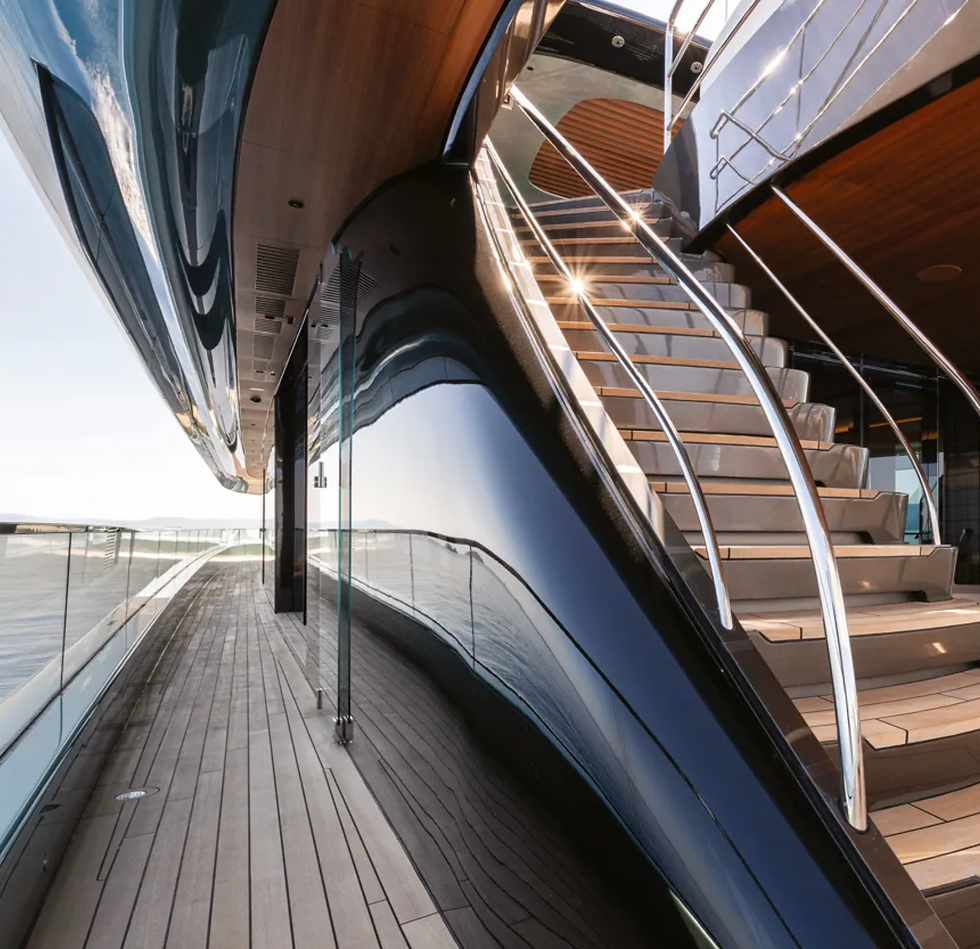

“there is a strong interest to replace the conventional carpeting in entries, galleys and lavatories with stone or wood veneers, which are actually quite thin and are mounted on carbon fiber panels, creating beautiful, durable floors that actually weigh about as much as the carpeting they replace.”
T H O M A S C H A T F I E L D / C A M B E R A V I A T I O N M A N A G E M E N T
Photograph by: Colin Chatfield
P H I L O S P H Y /
A S S O C I A T I O N / I N Q U I R Y
The agency’s philosophy is to place design at the heart of its clients’ strategy and use it as a growth driver. The tools employed in its design approach include market analysis, design thinking, ergonomics, user experience, and design-to-cost methodologies.
Since its founding, DE LUSSAC has had the privilege of collaborating, in France and internationally, with companies such as Bell & Wyson, La Poste, AFF Mobilier Urbain, Davidoff, Ellip6, La Pierre de France, and Roche Bobois, on more than 200 projects.
The agency publishes its own collection under the T2L brand, which is sold in 37 countries.
The Human Element
Beyond the technical achievements, VVIP aircraft design is ultimately about creating deeply personal spaces. Designers often develop close relationships with clients, understanding their cultural backgrounds, aesthetic preferences, and lifestyle needs. Whether creating a flying extension of a royal palace that honors cultural traditions or designing an ultra-modern space for a tech entrepreneur, the reward comes from translating personal visions into reality and seeing a client's face light up upon first experiencing their custom aerial domain.
The Pitfalls: Where Dreams Meet Technical & Regulatory Reality
Regulatory Compliance
Complexity The most beautiful concept means nothing if it cannot be certified for flight. Every element in a VVIP aircraft—from the smallest decorative detail to major structural modifications—must comply with stringent aviation regulations. Materials must meet flammability standards, furniture must withstand specific g-forces during emergency landings, and weight distributions must fall within precise parameters. These requirements often clash with design aspirations, leading to countless engineering compromises and redesigns that can frustrate both designers and clients.
The Weight Equation
Physics remains the ultimate arbiter in aircraft design. Every kilogram added to an aircraft increases fuel consumption, reduces range, and impacts performance. Yet VVIP interiors typically involve heavy monuments, such as Showers, Bars, Extensive Cabinetry, Bulkheads, Walls, and almost always Special Decorative Features. And then there are the finish materials – things like marble or granite surfaces, custom CNC’d decorative metal trims, lighted ceiling treatments etc. Even though there are aircraft-grade lightweight veneers for elements like natural stone, the weight penalties for these materials quickly add up. Interestingly, as Tom Chatfield from Camber Aviation Management notes, “there is a strong interest to replace the conventional carpeting in entries, galleys and lavatories with stone or wood veneers, which are actually quite thin and are mounted on carbon fiber panels, creating beautiful, durable floors that actually weigh about as much as the carpeting they replace.”
But the good news is that all narrow and wide-body jets were designed for commercial use with passenger loads of sometimes hundreds. Obviously, when you take one of those airframes into private use, your PAX load moves dramatically down to perhaps eight to fifteen passengers – depending on the aircraft and your own mission profile. So, there is somewhat of a leveling equation there – but you still need to remember that every pound ounce of added weight, reduces range, increases fuel burn, max gross take-off, and other factors. It becomes a factor in almost every decision you make.

A B O U T T H O M A S D E L U S S A C


LEARN MORE AT : www.delussac.fr
INQUIRIES: contact@delussac.fr
VOTING OPPORTUNITY / INTERNATIONAL YACHT & AVIATION AWARDS
Design DE LUSSAC is a shortlisted finalists in the 2026 Design et al - Yacht & Aviation Awards For more information or if you would like to vote for
design DE LUSSAC, visit https://thedesignawards.co.uk/voting/


Reymond-Langton Design
Established in 2001 by the talented design duo of Pascale Reymond and Andrew Langton, both of whom already had over a decade’s experience in the superyacht industry, we are committed to creating designs that are as beautiful as they are functional whilst, at the same time, ensuring our clients’ expectations are not only met but exceeded, with projects being delivered on time and on budget. I
n 2002, Jason Macaree joined the team as a director. Coming from different creative backgrounds – Pascale gained a Master’s degree in Art History from La Sorbonne, Paris before moving to London to study Interior Design while Andrew and Jason graduated with a BA (Hons) in Transport Design – the team’s individual blend of skills and professional expertise are complementary, resulting in a remarkable and much sought after design team delivering unquestionable quality with superb attention to detail


Toys
Kensho knows a thing or two about fun on the water, with a selection of water toys and accessories for you and your guests to enjoy whilst on charter. Take to the sea on the Jet Skis offering you power and control on the water. Also there are towable toys offering fun and adventure. Another excellent feature are three SEABOBs, offering a truly remarkable experience that lets you skim along the surface or swim with the fishes quietly and safely. If that isn't enough Kensho also features bikes, inflatable water toys and paddleboards. When it comes to Tenders, Kensho has you covered - with three tenders, including a 13m/42'8" Alia Yachts Chase Tender.
Book your next Bermuda and the Caribbean luxury yacht charter aboard Kensho this winter. She is already accepting bookings this summer for cruising in the Mediterranean.
C H A R T E R I N F O R M A T I O N
https://www.yachtcharterfleet.com/



113 M "REVIVAL" by designer Issac Burroughs

R I V A - I T A L I A N H A N D C R A F T E D W O O D E N B O A T S


Photograph by: Colin Chatfield

“While the risks always remain, it is the task of the outfitter’s engineering team and the completion manager to develop processes to allow the various components and software to be tested thoroughly on the work bench to identify issues while there is still time to thoughtfully (and not under the pressures of an upcoming completion date) to identify and implement solutions before the systems are installed.”
- Tom Chatfield
10
INSTALLMENT

10


The joy will outweigh the perils every time if you simply plan before you move and employ the right resources. Foresight and Predictability is everything in lage complex completions.
Photograph by: Colin Chatfield



Courtesy: Camber Aviation Manageme



The Jet Business is the world's first and only street-level aviation showroom for the marketing and acquisition of corporate jet aircraft. Headed by Steve Varsano and based in London, The Jet Business represents its clients throughout the aircraft acquisition process, offering the most up-to-date product information, global market data, extensive industry relationships
and universal world-class expertise.
Explore the options of jet ownership. Learn more.





The Continental GT, Flying Spur and Bentayga are the very definition of a modern Bentley line-up, all built with the words of the founder, W.O Bentley ringing in the air: “I want to build a fast car, a good car, the best car in its class.”


When you open the door to the Lou Hansell Bespoke studio, the possibilities begin. Our artisans and designers have selected a palette of exquisite materials, with 51 shades of ltalian leathers, five metal and inner trim pairings, and personalization options. Driven by their boundless creativity, they combine their talents and craftsmanship to create pieces you’ll cherish forever.

.png)